Hand signals are an alternative to using your turn signals when your turn signals are not operable. This may happen for instance when a turn signal bulb has burnt out or a fuse has blown.
How Should You Hand Signal?
A hand and arm or directional signal of intention to turn or move a vehicle right or left must be given continuously during the last 100 feet traveled by the vehicle before turning. As a safety precaution, the signal may be given from a greater distance when warranted by traffic conditions or the higher speeds of your vehicle.
Never stop or suddenly decrease the speed of your vehicle without signaling your intentions for the benefit of the other drivers.
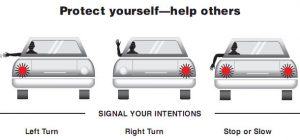
Use hand signals when the sun is shining brightly or when a line of cars following you could obscure your turn signal light. Be sure that turn signal lights (front and rear) are clean and free from dust, dirt, ice, or snow.
Alaska law requires you to cancel your directional signal light after you use it. Your unintended signal still means you plan to turn to the other drivers. You might tempt another driver to turn or drive across in front of you.
Correct Left Turn Steps
Example 1
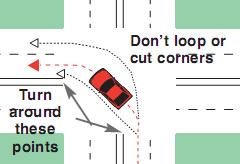
- Get into proper lane well ahead of turn.
- Signal intention to turn for at least 100 feet.
- Yield to all oncoming vehicles.
- Yield to pedestrians.
- Turn into proper lane.
- Don’t loop or cut corners.
Example 2
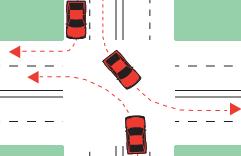
- Watch traffic light cycle.
- Wait for oncoming vehicles in the intersection. Don’t proceed past the center of intersection.
- Keep front wheels straight while waiting.
- Look out of left window for pedestrians and check turn path.
Two Way Street to One Way Street
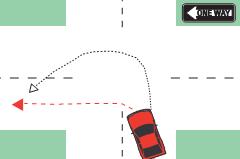
- Make proper “two way” approach.
- Signal intention to turn for at least 100 feet.
- Yield to all traffic.
- Do not turn before reaching the crosswalk.
- Look out of left window for pedestrians and check turn path.
- Turn sharply into first lane.
Turning on One Way Roads
One Way Street to Two Way Street
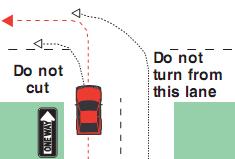
- Make approach in the traffic lane furthermost to the left on one way street.
- Signal intention to turn for at least 100 feet.
- Don’t start turn at the crosswalk.
- Drive into the intersection and then turn sharply into lane shown.
Left Turn One Way Street to One Way Street
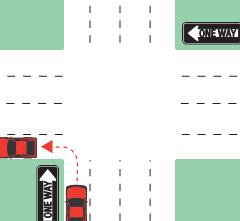
- Make approach in the traffic lane furthermost to the left of the street.
- Signal intention to turn for at least 100 feet.
- Look out of left window for pedestrians and check turn path.
- Turn sharply into the first lane on the left side of the one way street. LEFT turn one way street to one way street
Right Turn Two Way Street to Two Way Street
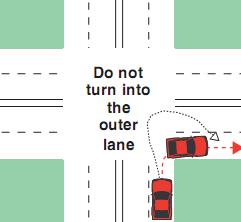
- Signal intention to turn for at least 100 feet.
- Get into proper lane well ahead of turn.
- Look out of right side of windshield for pedestrians and check turn path.
- Be alert for vehicles ahead that are turning right and may stop for pedestrians.
- Right turn two way street to two way street
Three Point Turn
Three point turns allow you to turn around in a narrow space. They involve pulling up to the car on one side of the road, backing up toward the other side of the road, and then turning around.
Unless prohibited, you may use the “three point turn” to turn around on a narrow street.
- Signal your intention to turn right. Pull over to the far right and stop.
- Signal your intention to turn left. Check for traffic.
- If traffic is clear, turn left crossing the street until your vehicle is pointing at the curb or left shoulder of the road.
- Check again for traffic. Turn your wheels to the right as far as they will go. Back up to the opposite side of the street.
- Stop, check again for traffic. Drive forward to complete your turn around maneuver.
Be careful when making this turn. Watch for and yield to approaching traffic or pedestrians. For extra safety, you could give a couple short blasts of the horn before backing up. Many mechanics do this when moving cars into and out of garage bays for additional safety.